HRMS Software for South African Businesses
Learn how to choose HRMS software in South Africa by comparing payroll, PAYE, UIF, SDL, ETI, attendance, integrations, data protection, implementation and cost.

Nathan HRMS is HRMS software for South African businesses that need one system for employee records, recruitment, attendance, leave, payroll, Pay-As-You-Earn (PAYE), Unemployment Insurance Fund (UIF) contributions, approvals and workforce reporting.
It connects the information used across HR, payroll, finance and operations so that each function works with the same employee records. This gives you greater control over workforce processes, reduces repeated administration and provides management with a consolidated view of its people and payroll costs.
This guide explains what Nathan HRMS includes, how its capabilities support South African operations and what implementation can involve.
Keep Employee Information and HR Processes Connected
Nathan HRMS provides a central employee record covering recruitment, onboarding, employment changes and departure.
Recruitment teams can publish vacancies, manage applications and track candidates through defined hiring stages. AI-assisted candidate screening helps organise initial application reviews, while hiring managers can record interview feedback and decisions within the platform.
Once a candidate is hired, their information can move into the employee record without creating another profile manually. HR can then manage personal details, employment information, reporting lines, documents, approvals and organisational data through the same system.
The platform supports:
Recruitment and applicant tracking
Candidate-to-employee conversion
Onboarding and offboarding
Internal transfers
Employee reboarding
Departments, branches and reporting structures
Company policies and documents
Multiple companies and legal entities
For organisations operating across several branches, sites or legal entities, this provides a shared workforce structure while preserving the access controls required by each business unit.
Connect Attendance and Leave Directly to Payroll
When attendance, leave and payroll operate through separate processes, payroll teams need to collect, reconcile and check information before every pay run.
Nathan HRMS connects approved attendance, leave, overtime, commissions and other payroll inputs with the employee record. Employees can record attendance through supported biometric devices, mobile check-ins or GPS-based check-ins, depending on your configuration.
You can configure:
Work schedules and rosters
Attendance rules
Leave types and balances
Overtime policies
Approval routes
Attendance exceptions
Manager permissions
Managers can review exceptions and approve employee requests within the platform. Once approved, the information is available for payroll without maintaining a second attendance record.
This gives HR, payroll and operations a shared process for managing employee time while preserving an approval trail for review.
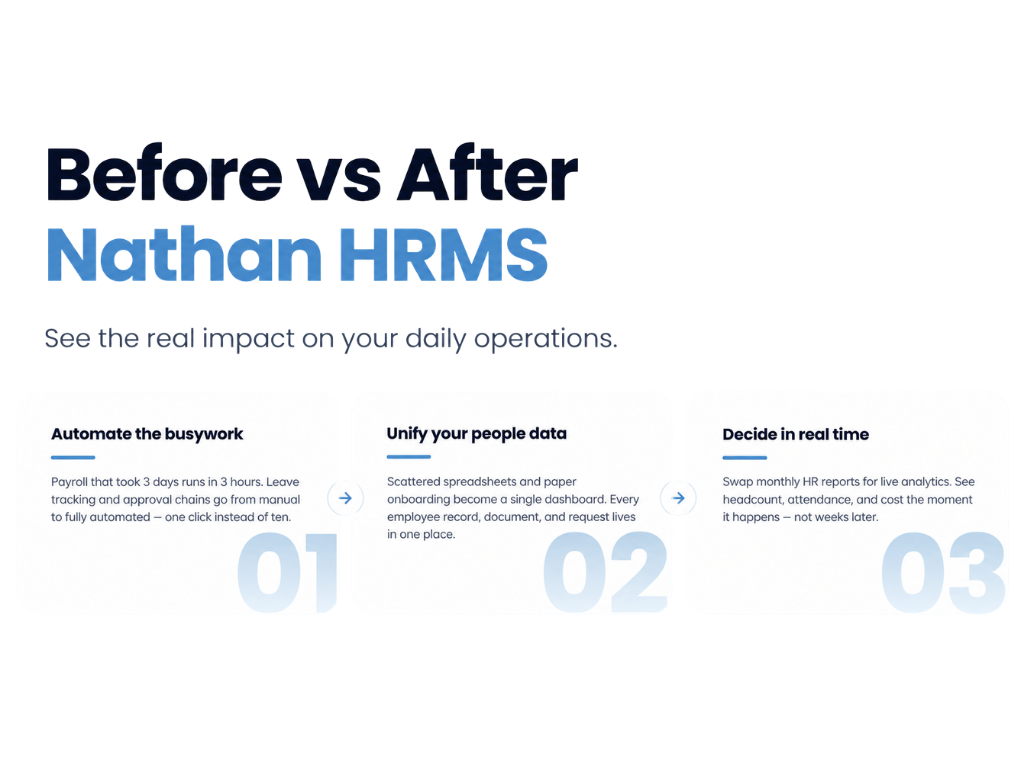
Manage South African Payroll and Statutory Deductions
Nathan HRMS supports payroll processing for South African businesses, including the employee information, earnings and deductions used for statutory payroll administration.
Payroll can bring together:
Basic salary
Approved attendance and overtime
Leave inputs
Allowances and deductions
Commissions and incentives
PAYE
Skills Development Levy (SDL)
UIF contributions
Employment Tax Incentive (ETI), where applicable
Employee payslips
Payroll and finance reports
Authorised users can review payroll information before approval. Employees can then access their payslips through the employee portal or mobile app.
According to the South African Revenue Service guidance on PAYE, the Monthly Employer Declaration (EMP201) records the employer’s PAYE, SDL, UIF and applicable ETI allocations.
Nathan HRMS helps payroll teams maintain the employee and payroll information required for these calculations and declarations. Your configuration should reflect your payroll rules, earning types, deduction codes, approval process and finance requirements.
Prepare Employer Declarations and Reconciliations
South African payroll administration extends beyond calculating monthly salaries. Employers also need payroll records that support monthly declarations, reconciliation periods and employee tax certificates.
Nathan HRMS can support payroll information and outputs used for:
Monthly EMP201 declarations
Interim and annual EMP501 reconciliations
IRP5 and IT3(a) employee tax certificates
PAYE, SDL and UIF reconciliation
ETI information, where applicable
Payroll reports and audit records
SARS requires the figures in an EMP501 to reconcile with the relevant EMP201 declarations, payments and IRP5/IT3(a) certificates. Its employer reconciliation guidance explains that reconciliations are required for both interim and annual periods.
Keeping salary, deduction, payment and employee information within one payroll process helps your team review the figures before preparing statutory submissions. The final submission and approval responsibilities remain with your organisation and authorised payroll or tax representatives.
Give Employees Access Without Losing HR Control
Employee self-service reduces the number of routine requests handled directly by HR while keeping access governed by role and permission.
Through the Nathan HRMS web portal or mobile app, employees can:
Review payslips
Submit leave requests
Check leave balances
Upload documents
Update permitted personal information
Record attendance through configured methods
Managers can review team attendance, respond to requests and complete approvals without relying on email threads or manually maintained trackers.
Notifications can connect with Microsoft Teams, Slack, WhatsApp and email, depending on the integrations selected. Support for multiple languages also helps organisations provide access across diverse workforces.
Manage Performance and Employee Development
Nathan HRMS links performance management to the employee’s role, department and reporting structure.
Managers can define goals and key performance indicators (KPIs), complete performance reviews, collect 360-degree feedback and create development plans. Authorised teams can also use calibration tools to review performance outcomes across departments or employee groups.
Learning and development activity can be recorded alongside performance information. This gives HR and management a consolidated view of employee goals, feedback, development activity and review history.
Give Management Better Workforce Visibility
Nathan HRMS provides dashboards and reports covering areas such as:
Headcount
Attendance and absence
Leave
Payroll
Recruitment
Employee turnover
Performance
Workforce costs
Access can be configured by role so that HR, finance, payroll and management teams see information connected to their responsibilities.
AI-assisted reporting tools allow authorised users to ask workforce questions and generate summaries using information available in the platform. This supports management reporting without distributing multiple versions of employee and payroll spreadsheets.
Connect HRMS Data With Your Existing Systems
An HRMS needs to work with the systems already used by finance, IT, operations and payroll.
Nathan HRMS provides more than 35 prebuilt integrations and an open application programming interface. Supported integration categories include:
ERP and finance systems such as SAP, Oracle, Microsoft Dynamics, QuickBooks, Xero and Tally
Identity platforms such as Microsoft Entra ID, Okta and Google Workspace
Biometric attendance devices
Banking and payroll processes
Microsoft Teams, Slack, WhatsApp and email
Custom connections through REST APIs and webhooks
Integration planning should establish which system owns each data field, how information moves between platforms and who is responsible for reviewing unsuccessful transfers.
This helps prevent duplicate employee records and conflicting information across HR, finance and operational systems.
Apply Permissions, Security Controls and Audit Records
Nathan HRMS contains identity information, bank details, salary records, employment history and other personal information. Access therefore needs to reflect each user’s responsibilities.
The platform provides role-based permissions, authentication controls, encrypted data storage and activity logging. Its security framework also covers backups, infrastructure monitoring, database separation and controlled access to stored files.
Audit records allow authorised teams to review system changes, approvals and user activity. Permissions can be configured for employees, managers, HR administrators, payroll teams and other approved roles.
These controls should form part of your organisation’s broader data governance, retention and incident-management processes under the Protection of Personal Information Act (POPIA).
Configure Nathan HRMS Around Your Organisation
Nathan HRMS can be configured around your entities, branches, departments, reporting lines, approval routes, attendance policies and payroll requirements.
Implementation can include:
Reviewing your current HR and payroll processes
Configuring companies, branches and reporting lines
Setting attendance, leave and approval rules
Preparing and validating employee data
Configuring earnings, deductions and statutory payroll fields
Setting up payroll and reconciliation reports
Connecting approved integrations
Testing workflows and payroll calculations
Training administrators, managers and employees
Launching the platform in agreed stages
Historical employee and payroll information should be validated during migration. Parallel testing can also be used to check payroll results before the system becomes the primary payroll environment.
The implementation scope will depend on your workforce size, number of entities, payroll structure, data quality and integration requirements.
Nathan HRMS Capabilities for South African Businesses
.png)
Bring Your South African Workforce Operations Into One System
Nathan HRMS gives South African businesses one platform for managing employee records, recruitment, attendance, leave, payroll, statutory information, performance and workforce reporting.
For HR and payroll teams, this reduces repeated administration and provides a structured approval record. Finance and management gain access to reliable workforce and payroll information, while employees can manage routine requests without removing HR oversight.
You can book a Nathan HRMS demonstration to review the payroll configuration, workflows, integrations and reporting required for your organisation.