HR Software for Mining Companies South Africa
Learn how Nathan HRMS supports South African mining companies with employee records, attendance, shifts, leave, payroll inputs and workforce reporting across sites.

HR software for mining companies in South Africa should connect employee records, location assignments, attendance, shifts, leave, payroll and reporting. Nathan HRMS brings these processes into one platform and can be configured around an employer’s structure, pay rules and approval routes.
For mining operations where teams work across locations, departments and rotating schedules, the main benefit is a connected route from the employee record and site activity into payroll, reports and management decisions.
Why Mining Companies Need Connected Workforce Information
Mining workforce administration often involves separate locations, shift patterns and reporting lines. Attendance, overtime and leave influence operational coverage and payroll. When sites use different files or systems, HR and payroll teams spend time matching records before they can finalise a pay run or investigate a workforce figure.
A connected HRMS gives each employee one record and links that record to the relevant location, department, manager, attendance history and payroll information. This helps an authorised manager understand where an exception started and what was approved, without requesting another spreadsheet from HR.
How Nathan HRMS Fits Mining Workforce Requirements
Keep Employee Records Connected Across Locations
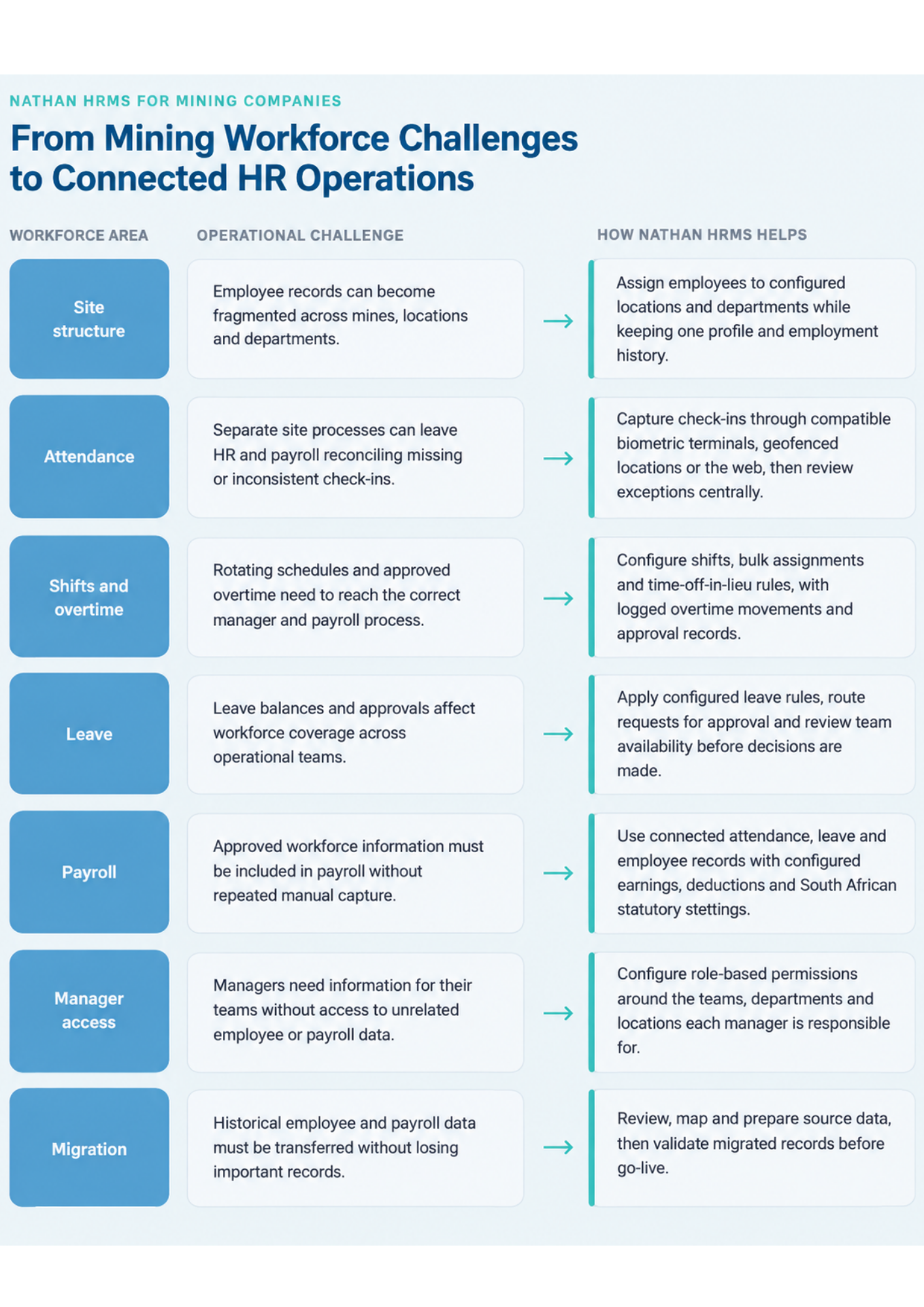
Nathan HRMS can be configured around the employer’s organisational structure. Employees can be assigned to locations and departments, while permissions determine which records a manager can access. If an employee transfers internally, the existing profile and employment history remain intact instead of starting again under a new record.
For a mining company, this creates continuity when an employee moves between departments or operating locations. HR can trace previous assignments and payroll history, while each manager works with the employees within their area of responsibility.
Connect Attendance, Shifts, Leave and Payroll
Nathan HRMS attendance, leave and shift tools can capture check-ins from compatible biometric terminals, geofenced locations or the web. Dashboards show attendance status, and exception reports help HR identify missing or inconsistent records before payroll.
Shifts can be assigned in bulk or configured using department and employee eligibility. Overtime can be recorded through configurable time-off-in-lieu rules, including multipliers, expiry or payout settings. Leave types, accruals, balances and approval routes can also be configured around the employer’s policies.
The operational benefit is a connected approval trail. A missed check-in, overtime entry or leave request can be reviewed by the responsible manager before the approved information reaches payroll. This reduces the need to capture the same information again in a separate payroll file.
Example Mining Workflow From Check-In to Reporting
The following example shows how a connected mining workforce process could be configured during implementation.
An employee is assigned to a configured location, department, shift pattern and manager within the organisational structure.
The employee records attendance through a compatible biometric terminal, geofenced location or the web.
An exception, correction request, leave request or overtime entry moves to the responsible manager for review.
Approved attendance, leave and other configured earnings or deductions are included in the payroll process.
Payroll uses the same employee record to calculate gross-to-net pay and the configured South African statutory amounts.
Managers view workforce reports for the locations, departments or teams covered by their permissions.
This sequence is important during a demonstration because it tests the connection between modules. It also exposes configuration questions before implementation, such as device compatibility, approval ownership, shift rules, payroll cut-off dates and access permissions.
Support South African Payroll Requirements
The Nathan HRMS payroll module supports gross-to-net calculations, allowances, additions, deductions, payroll-cost reporting and payroll across multiple entities. For South Africa, PAYE, Skills Development Levy, Unemployment Insurance Fund and Employment Tax Incentive calculations are supported, together with EMP201, EMP501 and IRP5/IT3(a) reporting.
South African Revenue Service guidance explains that EMP201 declarations include PAYE, SDL, UIF and ETI allocations, while EMP501 reconciliations cover employee tax certificates such as IRP5/IT3(a). The employer remains responsible for reviewing its declarations, payments and submissions.
During implementation, the payroll structure, earning and deduction codes, statutory settings and approval rules must be configured for the employer. Mining-specific allowances, overtime provisions and rules from employment contracts or collective agreements should be tested before the first live pay run.
Give Employees and Managers Mobile Access
Employees who spend limited time at a desk still need access to attendance, requests, approvals, payslips and HR information. The HR Direct mobile app provides access on iOS and Android, allowing employees and managers to complete routine HR actions away from a central office.
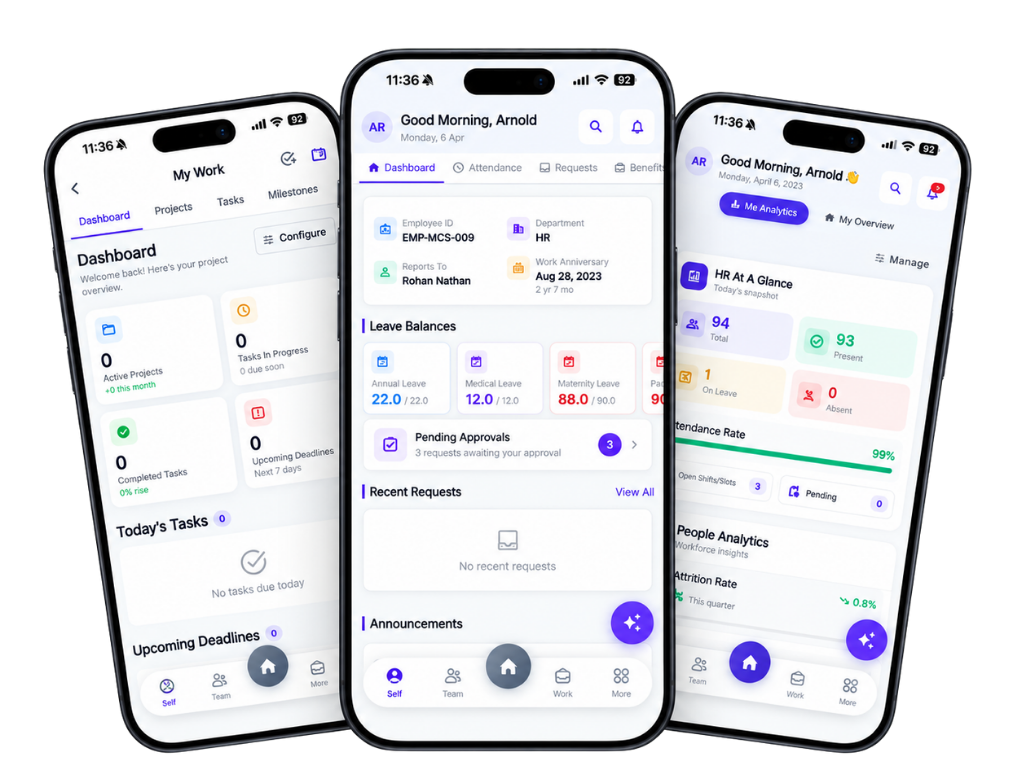
Before rollout, the implementation team should assess device access, connectivity, authentication, employee support and the attendance method used at each location.
Protect Workforce and Payroll Data
Nathan HRMS security controls include a separate database and private file storage for each organisation, encryption, field-level permissions, audit logs and activity tracking. Production infrastructure is hosted in Frankfurt, Germany.
Because mining employers hold identity, bank and remuneration information, the security review should cover access levels, retention settings, incident processes and cross-border processing under the Protection of Personal Information Act. The organisation remains responsible for its legal assessment and internal information-security policies.
Section 31 of the Basic Conditions of Employment Act requires employers to keep prescribed employee records, including occupation, time worked and remuneration paid, for three years from the date of the last entry.
Migrate Historical Records and Test Before Go-Live
Historical employee and payroll records can be migrated into Nathan HRMS, but migration must be managed as an implementation project. The source data must be assessed, mapped and prepared before it is loaded into the new system.
After migration, the implementation team should validate employee profiles, assignments, leave balances, payroll history and opening values. Testing should identify missing, duplicated or incorrectly mapped records before go-live. Payroll parallel testing can then compare the configured system with the expected calculations and outputs.
This stage is also where the employer tests employee transfers, manager permissions, attendance devices, approval routes and the complete route from attendance to payroll and reporting.
What to Ask for in a Mining HRMS Demonstration
A product demonstration should use a representative mining workflow instead of separate feature screens. Ask the provider to show:
How an employee is assigned to a location, department, shift and manager.
How an internal transfer preserves the employee profile and history.
How biometric, geofenced or web attendance is captured and corrected.
How leave and overtime move through approval and into payroll.
How South African statutory calculations and reports are produced.
How managers see information for their areas of responsibility.
How payroll and employee data are protected.
How historical records will be mapped, migrated and tested.
These checks show whether the proposed configuration supports the full process and which requirements need additional scoping. They also give HR, payroll, operations, finance and IT a shared basis for evaluating the platform.
Book a Nathan HRMS Demonstration
Nathan HRMS can connect employee records, locations, attendance, shifts, leave, payroll, mobile access and reporting for South African mining companies. The platform is configured around the employer’s structure, rules, permissions and implementation requirements.
Book a demo to review a mining workforce scenario and identify the configuration, migration, testing and integration work required for your organisation.