HR Software for Real Estate and Property Management Companies in South Africa
Learn how Nathan HRMS supports South African property and real estate companies with employee records, attendance, leave, payroll, reporting and workforce management across branches and properties.

HR software helps South African real estate and property management companies manage employee records, attendance, leave, payroll and reporting across branches, offices and managed properties. It gives HR, payroll and operations teams one source of workforce information when employees work across several locations.
At Nathan Digital, our Nathan HRMS platform connects these processes to a central employee record. We configure the platform around your branches, departments, properties, reporting lines and payroll requirements.
Why Property Companies Need Connected Workforce Information
A property company can employ branch administrators, property managers, maintenance teams, finance staff and employees assigned to individual properties. Each group can work in a different location, follow a different schedule and report to a different manager.
Problems arise when branches keep separate spreadsheets or attendance systems. HR has to confirm which employee record is current, managers struggle to review information across their areas and payroll teams reconcile attendance, leave and variable earnings before every pay run.
Nathan HRMS brings these processes into one system while controlling which information each user can access.
Planned HRMS Implementation for a South African Property Group
A planned Nathan HRMS implementation for a national property management group shows how this approach can work. The group has over 500 employees across seven or more South African locations.
Its HR and payroll processes currently use LabourNet, Sage and SimplePay, while each branch has its own biometric attendance system. Payroll information is reconciled manually against biometric records, and management visibility across branches is limited.
The planned implementation includes employee records, payroll, attendance, shifts, leave, organisational structure, employee self-service, mobile access and reporting. The intended design will connect hours, attendance, leave and payroll to one employee record and give authorised managers branch-level information through shared dashboards.
The implementation is not live, so these are project objectives and confirmed implementation scope, not measured results.
How Nathan HRMS Supports Property Workforce Management
.png)
Managing Employee Records Across Properties
Separate location files can create duplicate profiles, missing documents and conflicting reporting lines when an employee changes branches or property portfolios.
Nathan HRMS gives each employee one record containing employment information, documents, reporting relationships and organisational assignments. Employees can be transferred between configured branches, departments or properties without creating a new profile, preserving their record and history.
Role-based permissions are configured around your reporting structure. This allows a property or regional manager to access the relevant workforce information without viewing unrelated employee or payroll records.
Recording Attendance and Leave Across Locations
A head-office employee and a maintenance employee working at managed properties will not always use the same attendance method.
Our attendance, leave and shift management tools support compatible biometric terminals, web check-ins and approved geofenced locations. Dashboards show lateness, absence and missing records, while exception reports help managers resolve gaps before payroll processing.
Nathan HRMS also supports configurable schedules, shift assignments, overtime rules, leave types and accrual rules. Managers can review leave balances and team calendars before approving an absence that could affect reception coverage, maintenance work or inspections.
Approved attendance and leave remain connected to payroll, reducing repeated entry between separate systems.
Processing South African Payroll and Variable Earnings
Our payroll management module supports gross-to-net salary sheets, allowances, additions, deductions, payroll-cost reporting and payroll across multiple entities.
The South African payroll module supports Pay As You Earn (PAYE), Skills Development Levy (SDL), Unemployment Insurance Fund (UIF) and Employment Tax Incentive (ETI) calculations. It also supports EMP201, EMP501 and IRP5/IT3(a) reporting, with your payroll structure and statutory settings configured during implementation.
SARS explains that the monthly EMP201 declares PAYE, SDL, UIF and ETI amounts where applicable. Employers also complete EMP501 reconciliations and issue IRP5/IT3(a) employee tax certificates.
Property companies can also pay commissions, incentives and other variable earnings. Nathan HRMS can capture these earnings and include them in payroll. Earning codes, calculation rules and approval workflows are configured according to the organisation’s remuneration process.
Giving Employees and Managers Mobile Access
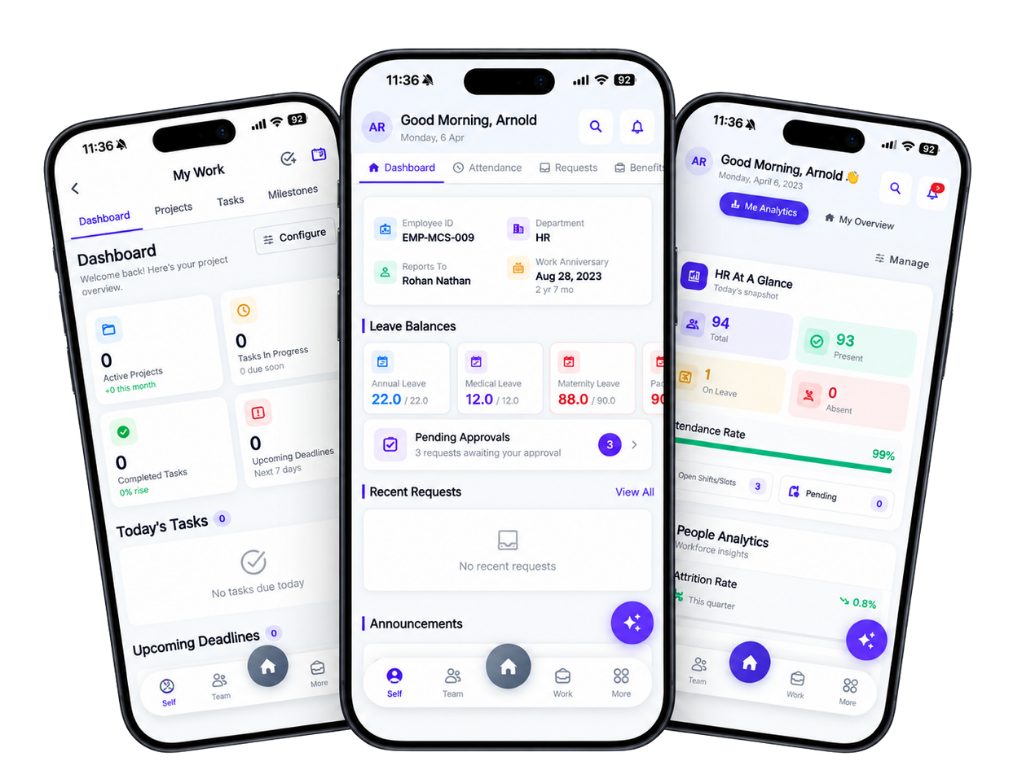
Property managers, maintenance employees and distributed teams still need access to HR information when they are away from head office.
Our HR Direct mobile app supports attendance check-ins, leave requests, approvals, payslips and HR documents on iOS and Android, online or offline. Employees can complete routine tasks from their phones, while managers can review requests when visiting properties or working away from a branch office.
Reporting and Employment Equity
Nathan HRMS provides dashboards and reports across employee, attendance, leave and payroll information. Head office can review consolidated workforce information, while regional managers can be restricted to their assigned branches, properties or teams.
Nathan HRMS also supports EEA2 and EEA4 reporting and allows organisations to track progress against applicable South African employment-equity sector targets. Employee data, reporting periods and permissions are configured around the organisation’s reporting requirements under the Employment Equity Act.
Protecting and Retaining Workforce Information
Property companies hold identity, employment, banking and payroll information that requires controlled access.
Nathan HRMS provides a separate database for each organisation, encryption in transit and at rest, field-level access controls and audit logs. Production infrastructure is hosted in Frankfurt, Germany.
Section 31 of the Basic Conditions of Employment Act requires employers to keep records that include each employee’s occupation, time worked and remuneration paid. These records must be retained for three years from the date of the last entry.
Access, retention and cross-border processing should also form part of the organisation’s Protection of Personal Information Act assessment. The Nathan HRMS security page explains the platform controls available for this review alongside the Protection of Personal Information Act.
Migrating Historical Employee and Payroll Records
Historical employee and payroll records can be migrated into Nathan HRMS as part of implementation. The source data must first be reviewed, mapped and prepared so that fields from existing systems correspond with the configured Nathan HRMS structure.
Migration testing is completed before go-live. Employee and payroll information is validated after transfer so that missing, duplicated or incorrectly mapped records can be addressed.
The implementation team also configures organisational units, access permissions, attendance methods, leave rules, payroll settings, variable earnings and reporting requirements. Representative workflows are tested before rollout.
Review Your Property Workforce Process With Nathan HRMS
A property business needs workforce information to move accurately between locations, managers, HR and payroll. Nathan HRMS connects employee records, attendance, leave, payroll, mobile access and reporting around the way your organisation operates.
During a demonstration, we can follow a representative process from your business, such as recording attendance at a managed property, approving leave, processing a commission or reviewing a branch workforce report.
Book a Nathan HRMS demonstration to discuss your workforce structure and see how the platform could support your real estate or property management operations.